Why AI Literacy Requires Ethical Literacy
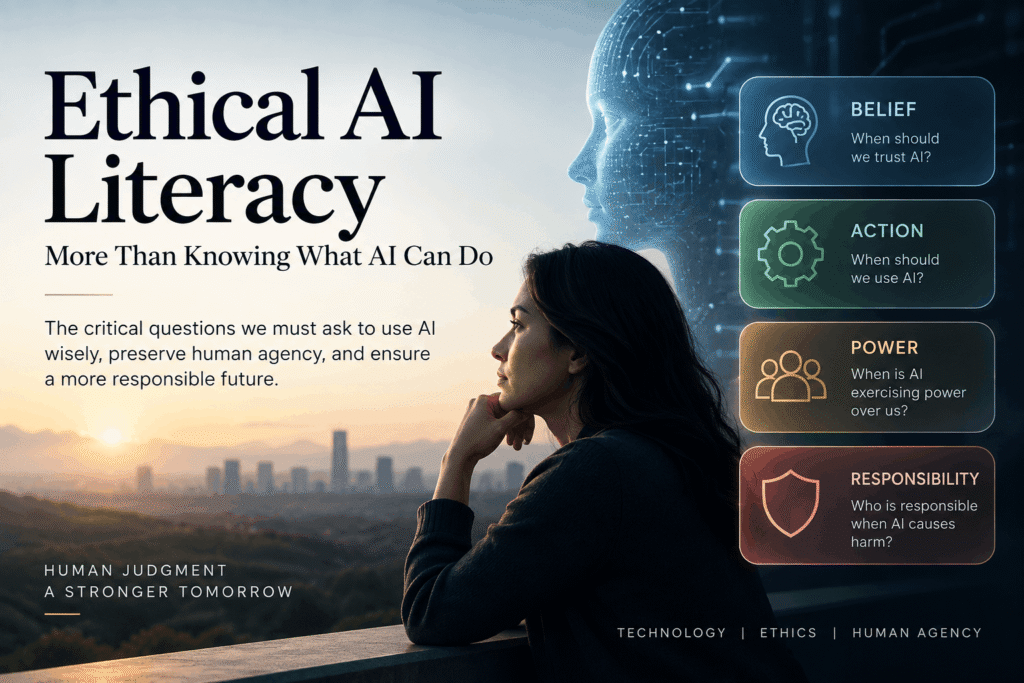
AI literacy is not enough. Using artificial intelligence responsibly also requires the capacity to decide when AI should be trusted, when it should be used, when it is exercising power over us, and who remains responsible when harm occurs. Ethical AI Literacy connects technological competence to the moral reasoning necessary to preserve human agency in an AI-mediated world.
Who Controls the Digital You? Surveillance, AI Profiling, and Synthetic Identity
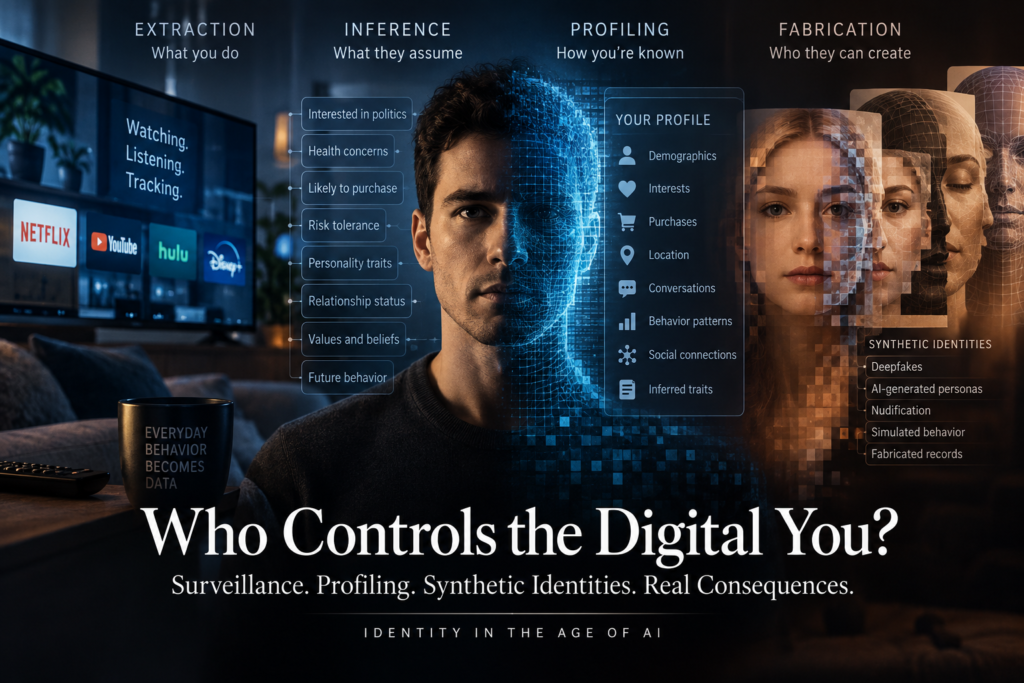
Digital systems no longer merely collect information about people. They can observe behavior, infer characteristics, construct persistent profiles, and fabricate new representations attached to recognizable identities. Smart-TV tracking, conversational AI memory, and synthetic nudification reveal a broader ethical problem: who has moral authority over the digital representations through which a person is known?
Executive Responsibility and the Moral Development of Agentic Artificial Intelligence

The rise of agentic artificial intelligence creates a responsibility problem before it creates a consciousness problem. Mark T. Holcombe examines functional agency, moral patienthood, AI alignment, open-weight models, and the heightened developmental responsibilities of frontier AI executives.
Political Deepfakes, Rage Bait, and the New Politics of Shitposting
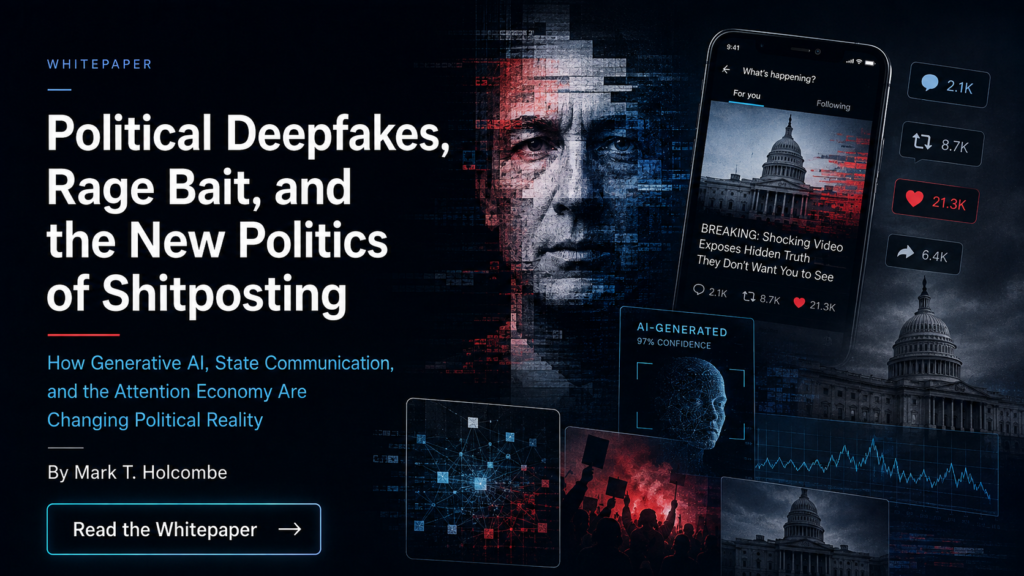
As the 2026 midterm election cycle accelerates, voters are entering an information environment shaped not only by political deepfakes, but also by rage bait, AI-generated imagery, cheapfakes, meme warfare, engagement farming, and increasingly provocative institutional communication. The central democratic problem is no longer simply whether a fabricated video can fool someone. It is whether citizens can still determine which evidence deserves trust when authentic footage, synthetic media, satire, propaganda, and emotionally optimized political content compete for the same attention. This analysis examines why that distinction matters during an election cycle in which the integrity of political evidence may be as important as the truth or falsity of any individual post.
Identity Ethics and the Distributed Self in the Age of Artificial Intelligence: Moral Rights over the Creation, Observation, Prediction, and Manipulation of Identity

Artificial intelligence is transforming identity from something primarily embodied and relational into a distributed digital construct that can be observed, predicted, synthesized, and manipulated. This whitepaper argues that traditional privacy and property frameworks are insufficient for addressing these developments. Instead, it proposes a structured account of qualified moral rights grounded in autonomy, dignity, fairness, digital integrity, and informational self-determination while examining deepfakes, biometric surveillance, predictive profiling, and identity governance.
Birmingham’s Data Center Debate: What City Council and the IDB Got Right, and Where They Failed

What happens when a city regulates AI infrastructure but fails to give affected communities a meaningful role in deciding where its burdens fall?
Birmingham’s new data center ordinance shows that city leaders recognized the need to regulate hyperscale AI infrastructure, but the process still left major ethical failures unresolved. Discussed is what Birmingham City Council and the Industrial Development Board got right, where they failed on public accountability, and why data center governance must address burden shifting, siting equity, and meaningful community participation.
This analysis is best understood through Mark T. Holcombe’s Applied AI Ethics Risk and Governance Framework (AERGF), which treats AI ethics as a governance problem involving stakeholder impacts, institutional responsibility, risk mitigation, and ongoing accountability rather than a narrow question of technical compliance or economic development.
Brain Death, Fetal Personhood, and the Moral Community

In season three of The Handmaid’s Tale, Natalie, slave-named Ofmatthew, is kept alive after being shot because she is pregnant. Her fetus becomes the physician’s patient, while Natalie becomes the biological infrastructure used to sustain that patient. The Georgia case involving Adriana Smith presents a disturbing real-world parallel, not because Georgia is identical to Gilead, but because fetal status becomes legally and medically powerful enough to displace the woman as the central patient.
This post is also written in recognition of Dobbs v. Jackson Women’s Health Organization, the 2022 Supreme Court decision that overturned Roe v. Wade, ended federal constitutional protections for abortion, and returned abortion regulation to the states. The Smith case forces a deeper ethical question: once fetal personhood enters law, what prevents the pregnant woman’s body, even after brain death, from becoming a site of state interest?
How Improper AI Use Undermines Rational Agency

Can AI use become a form of moral self-harm?
Many discussions of AI ethics focus on bias, privacy, and regulation. A less examined question is whether AI can harm the user. Drawing on Kantian ethics, recent empirical research, and the Holcombe Case-Based Moral Reasoning Framework, this article argues that improper AI use can undermine rational agency, critical thinking, and professional development, making certain forms of AI dependence ethically problematic.
Why Synthetic Science Threatens Epistemic Integrity, and What Ethical Analysis Reveals

The rise of AI-generated synthetic data presents a growing challenge to scientific integrity. This analysis applies the Holcombe Ethics Framework Suite to examine how institutional incentives, governance failures, and declining evidentiary transparency threaten the epistemic foundations of modern science.
AI Is Firing Employees. Who Is Morally Responsible?

Artificial intelligence is no longer limited to hiring decisions. Increasingly, AI systems monitor worker behavior, generate performance scores, recommend discipline, and in some cases contribute directly to employee termination. When an algorithm recommends firing a worker, who bears moral responsibility?
This article examines automated termination through the lenses of John Rawls’s Justice as Fairness, Robert Nozick’s libertarian theory of self-ownership, and Virginia Held’s ethics of care. Drawing on real-world examples from Amazon Flex and contemporary AI governance debates, it explores whether efficiency is enough to justify decisions that can cost workers their livelihood. As organizations adopt AI-driven management systems, the ethical question becomes increasingly urgent: Should algorithms assist human judgment, or replace it?