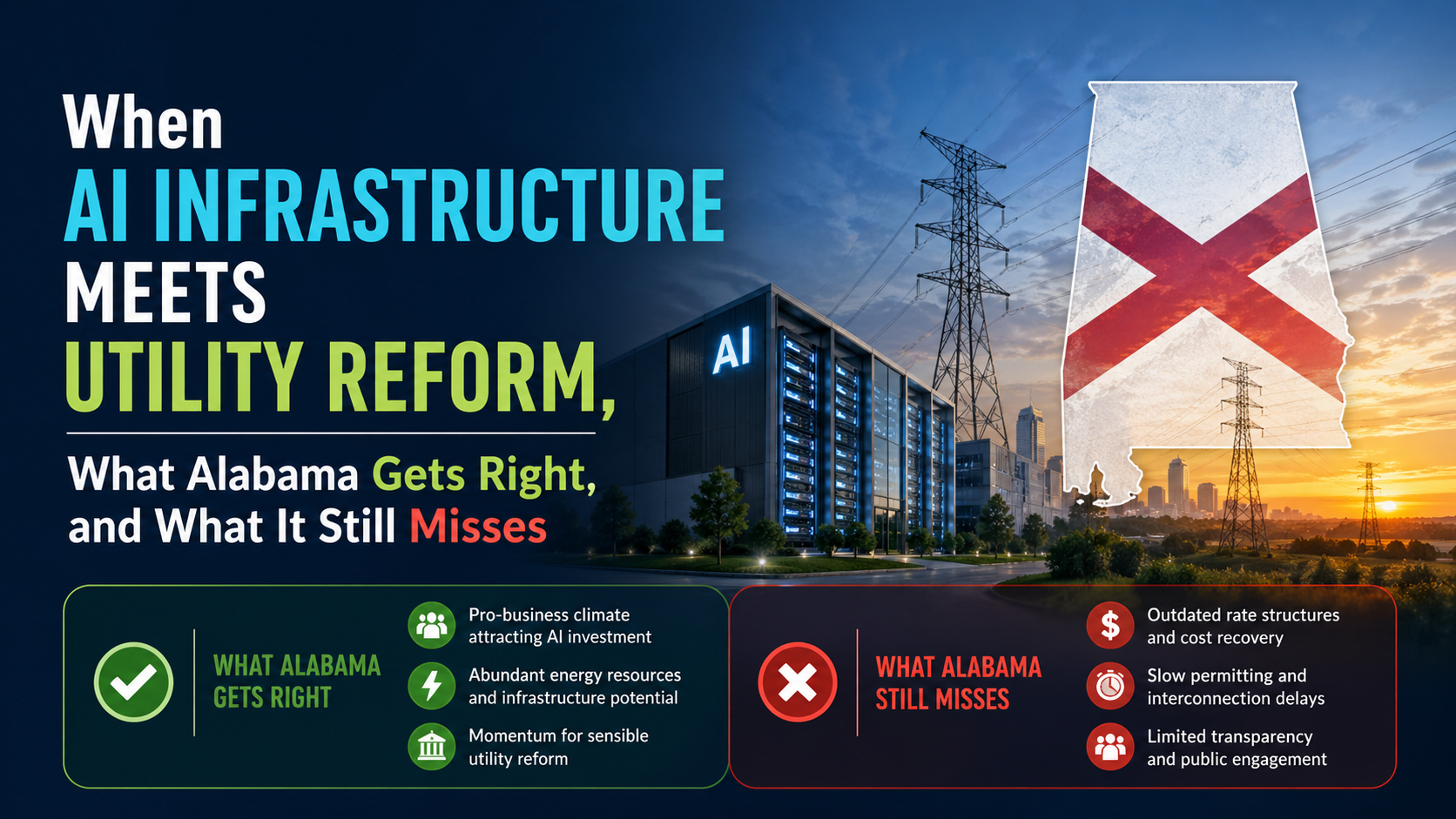
The “Cloud” is Grounded in Reality: Why Alabama’s New Utility Reform Matters
For years, we’ve spoken about the “cloud” as if it were ethereal—a weightless digital space where data lives. But as the AI boom accelerates, the physical reality is becoming impossible to ignore.
My recent article, “The Physical Weight of the Cloud,” highlights the staggering industrial footprint of our digital progress:
Water: A single AI conversation can “drink” 500ml of water for cooling.
Power: Massive data centers can consume 10x the electricity of an entire city like Birmingham.
Equity: Too often, these facilities are placed in “sacrifice zones,” burdening marginalized communities with noise, toxic emissions, and rising utility bills while providing minimal long-term jobs.
Alabama is drawing a line in the sand.
With the introduction of the bipartisan Alabama Affordability Protection Plan, state legislators are moving to ensure that the “physical weight” of technology doesn’t crush Alabama families.
Here is how the legislation addresses these ethical and economic challenges:
No More Subsidizing Private Profit (Bill 1): The plan requires data centers to pay the full cost of the grid and infrastructure upgrades they require. Existing utility customers will no longer see their rates hiked to pay for a tech giant’s expansion.
Incentives for Real Public Benefit (Bill 2): Gone are the days of blank-check tax breaks. New reforms align data center incentives with other industries, requiring “measurable public benefits” and reinvesting recovered dollars directly back into local communities.
Restoring Accountability (Bill 3): By restructuring the Public Service Commission (PSC) and prohibiting utilities from using consumer funds for lobbying, Alabama is moving toward a model that prioritizes transparency over special interest influence.
The Bottom Line
Innovation should not come at the cost of the most vulnerable. Alabama’s bipartisan approach provides a roadmap for how states can welcome the future of AI and data while protecting the resources and pockets of their citizens.
Shortcomings and Next Steps: The SB71 Factor
While the Affordability Protection Plan is a massive win for the pocketbooks of Alabamians, significant environmental and public health risks remain unaddressed—and may even be harder to solve due to other recent legislation like SB71.
SB71 prohibits Alabama agencies from adopting environmental rules (regarding water, air quality, or hazardous waste) that are more stringent than federal standards. This creates a dangerous “regulatory ceiling” for a few reasons:
- The Water Gap: Federal law often lacks specific, localized numeric standards for the massive, rapid water withdrawals required by AI Under SB71, Alabama may be powerless to set the stricter “water positivity” or replenishment standards necessary to protect our local watersheds.
- The “Manifest Harm” Hurdle: SB71 requires a “direct causal link” to “manifest bodily harm” before any new environmental rule can be established. In the context of “digital redlining,” where harm is often cumulative (noise pollution, particulates from diesel backups, and smog), this high legal bar makes it incredibly difficult for the state to protect communities in “sacrifice zones.”
- Transparency: The tech industry often uses NDAs to hide the local “physical weight” of their Without the ability for state agencies to demand more rigorous reporting than what the federal government requires, we remain in a data black box.
Digital progress is inevitable, but environmental and economic injustice is not. As we celebrate these utility reforms, we must keep pushing for the “Technology Justice” that allows Alabama to regulate the unique footprints of the AI age on its own terms.
References
- com. (2026). Bill that seeks to regulate data center boom in Alabama heads to governor’s desk. https://www.al.com/news/2026/04/bill-that-seeks-to-regulate-data-center-boom-in-alabama-heads-to-governors-desk.html
- Alabama Political Reporter (2026). State legislators introduce bipartisan Alabama Affordability Protection Plan.
Baxtel. (n.d.). Alabama data center market. Retrieved April 17, 2026, from https://baxtel.com/data-center/alabama
- Booker, D. (2025). Digital redlining: AI infrastructure and environmental racism in contemporary America.
Chesteen, D. (2026). Senate Bill 71. Alabama State Senate.
Li, P., Yang, J., Islam, M. A., & Ren, S. (2023). Making AI less “thirsty”. ArXiv.
- Clean (n.d.). Alabama data centers. Retrieved April 17, 2026, from https://cleanview.co/public/data-centers/alabama
- DC (n.d.). DC BLOX: Birmingham data center. Retrieved April 17, 2026, from https://www.google.com/viewer/place?mid=/g/11fcv7mnzr
- Governor Ivey’s (2024). Governor Ivey announces Meta plans to build $800 million, next-generation data center in Montgomery. https://governor.alabama.gov/newsroom/2024/05/governor-ivey-announces-meta-plans-to-build-800-million-next-generation-data-center-in-montgomery/
- (2026). Alabama data centers multiply as artificial intelligence fuels growth.
FAQ
What is the main ethical issue with AI data centers?
The primary ethical issue is the unequal distribution of costs and benefits, where communities often bear environmental and economic burdens while corporations capture most of the gains.
What does the Moral Displacement and Distribution Model (MDDM) explain?
MDDM explains how costs, environmental, economic, and social, are shifted onto less powerful groups while benefits are concentrated among dominant actors.
What does Alabama’s utility reform accomplish?
It reduces economic cost displacement by requiring data centers to pay for infrastructure, but it does not fully address environmental or cumulative harms.
Why is SB71 significant in this context?
SB71 limits Alabama’s ability to enact stricter environmental protections, creating a governance constraint that may prevent the state from addressing localized harms effectively.
Why does this matter for AI ethics?
It shows that AI ethics must account for physical infrastructure impacts, not just algorithmic behavior, and must analyze how those impacts are distributed across populations.
📩 Email to request the full white paper with policy recommendations and sample lesson frameworks for English Language Arts, Science, and Visual Arts.