Overview
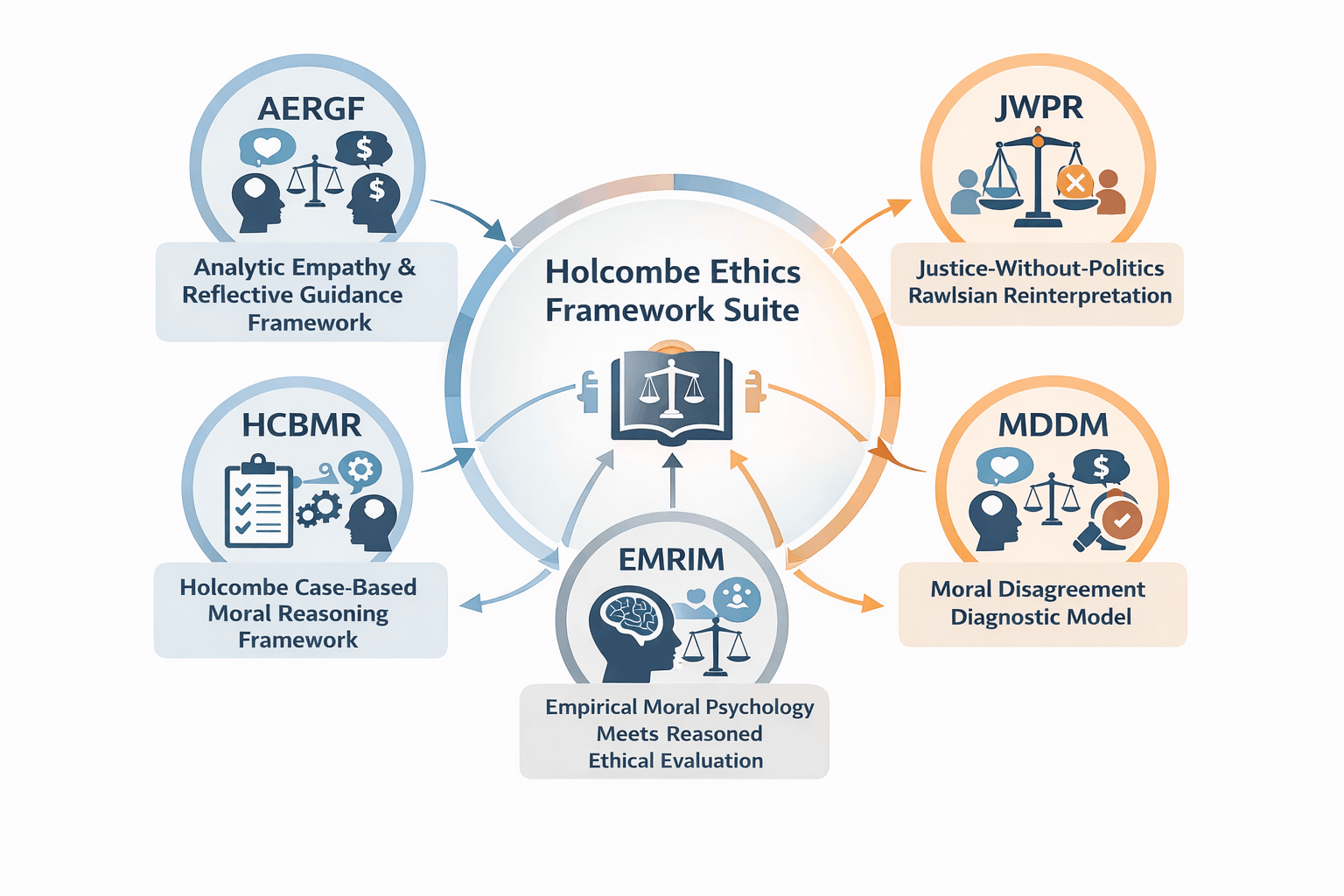
The Holcombe Ethics Framework Suite is an integrated set of five complementary frameworks developed by Mark T. Holcombe for teaching, analyzing, and applying ethical reasoning in education,
artificial intelligence, and organizational decision-making. Together, these frameworks treat ethics as a practical reasoning skill, not as abstract ideology or checklist compliance.
Purpose of the Framework Suite
The Holcombe Ethics Framework Suite was developed to address three persistent failures in ethics practice:
1. Ethics taught as theory memorization rather than reasoning
2. Moral disagreement treated as irrationality or bad faith
3. AI ethics reduced to slogans, bias metrics, or compliance documents
The framework suite provides a coherent methodology that integrates:
• Case-based reasoning
• Empirical moral psychology
• Normative ethical theory
• Disagreement diagnostics
• Governance and risk management
The Five Core Frameworks
Each framework serves a distinct role while reinforcing the others. They are designed to be used together or independently, depending on context.
1. Holcombe Case-Based Moral Reasoning Framework (HCBMR)
Function: Instructional and analytical foundation The Holcombe Case-Based Moral Reasoning Framework (HCBMR) is a structured approach to ethics education that develops moral judgment through systematic analysis of real-world cases rather than abstract theory alone.
Primary Uses
• Ethics education
• Teacher professional development
• AI ethics instruction
• Applied ethics training
Role in the Suite
HCBMR provides the method, how ethical reasoning is practiced.
2. Empirical Moral Reasoning Integration Model (EMRIM)
Function: Psychological and explanatory layer
The Empirical Moral Reasoning Integration Model (EMRIM) integrates empirical findings from moral psychology with normative ethical reasoning to explain why moral disagreement occurs and how ethical judgment can be improved through structured analysis rather than intuition alone.
Primary Uses
• Ethics education
• AI ethics dialogue
• Professional development
• Ethical decision analysis
Role in the Suite
EMRIM explains why people disagree morally before normative evaluation begins.
3. Moral Disagreement Diagnostic Model (MDDM)
Function: Analytical and diagnostic tool
The Moral Disagreement Diagnostic Model (MDDM) identifies the underlying sources of moral disagreement by isolating competing moral priorities, factual assumptions, and evaluative standards
before attempting resolution or judgment.
Primary Uses
• Facilitating ethical dialogue
• AI governance deliberation
• Organizational ethics review
• Policy and stakeholder analysis
Role in the Suite MDDM diagnoses where disagreement actually originates.
4. Justice-Without-Politics Rawlsian Reinterpretation (JWPR)
Function: Normative structure for justice reasoning The Justice-Without-Politics Rawlsian Reinterpretation (JWPR) separates Rawls’s core moral principles from contemporary political assumptions, allowing pluralistic and libertarian responses without relying on straw-man objections or partisan framing.
Primary Uses
• Ethics and political philosophy education
• AI governance and distributive justice analysis
• Cross-ideological ethical dialogue
Role in the Suite JWPR supplies normative structure without ideological foreclosure.
5. Applied AI Ethics Risk and Governance Framework (AERGF)
Function: Applied and organizational implementation layer The Applied AI Ethics Risk and Governance Framework (AERGF) provides a structured method for identifying, evaluating, and mitigating ethical risks in AI systems by integrating moral reasoning, governance structures, and accountability mechanisms.
Primary Uses
• AI ethics consulting
• Organizational governance
• Risk management and compliance
• Public-sector and nonprofit AI deployment
Role in the Suite AERGF translates ethical reasoning into institutional practice.
How the Frameworks Work Together
The Holcombe Ethics Framework Suite is intentionally layered:
1. HCBMR establishes how ethical reasoning is practiced
2. EMRIM explains why intuitions and disagreements arise
3. MDDM diagnoses the structure of disagreement
4. JWPR supplies justice-based normative reasoning
5. AERGF operationalizes ethics within organizations and AI systems
This sequencing is critical. Skipping layers reduces clarity and increases error.
Application Domains
The framework suite is used across multiple domains:
• Ethics education (secondary, undergraduate, professional)
• Teacher professional development
• AI ethics and AI governance
• Organizational ethics and compliance
• Policy analysis and stakeholder engagement
Authorship and Attribution
The Holcombe Ethics Framework Suite was developed by Mark T. Holcombe, ethicist, educator, and author of Critical Moral Reasoning. The suite reflects Holcombe’s work integrating applied ethics, empirical moral psychology, and structured reasoning across educational and AI ethics contexts.
References
Haidt, J. (2012). The righteous mind: Why good people are divided by politics and religion. Pantheon
Books.
Rawls, J. (1971). A theory of justice. Harvard University Press.
Greene, J. D. (2013). Moral tribes: Emotion, reason, and the gap between us and them. Penguin Press.
Floridi, L., Cowls, J., Beltrametti, M., et al. (2018). AI4People, an ethical framework for a good AI
society. Minds and Machines, 28(4), 689–707. https://doi.org/10.1007/s11023-018-9482-5
Ilievski, F., Garijo, D., Chalupsky, H., & Gil, Y. (2018). A semantic approach to content structuring for
knowledge extraction. Journal of Web Semantics, 52–53, 1–15.