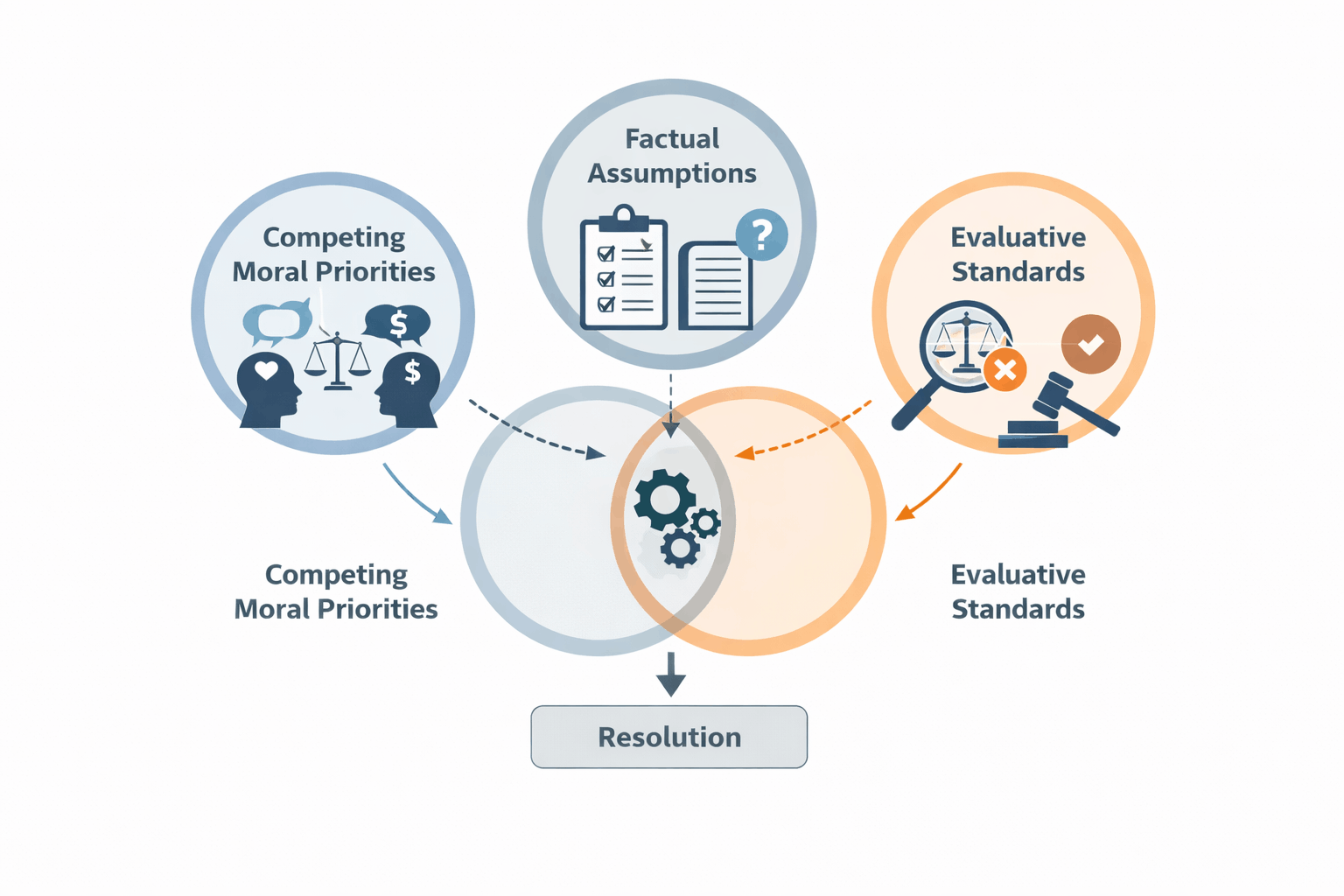
Definition
The Moral Disagreement Diagnostic Model (MDDM) is a structured analytical framework for identifying the underlying sources of moral disagreement by isolating competing moral priorities,
factual assumptions, and evaluative standards before attempting resolution or judgment.
The Problem This Framework Solves
Most moral debates fail because participants argue at the level of conclusions rather than causes.
Common failure modes include:
• Talking past one another
• Treating disagreement as bad faith or ignorance
• Escalating conflict without clarifying values
• Applying ethical theories prematurely
MDDM addresses this by treating moral disagreement as a diagnostic problem, not a rhetorical contest.
Core Insight of MDDM
People rarely disagree because they reason incorrectly. They disagree because they are answering different moral questions without realizing it. MDDM makes those hidden questions explicit.
Diagnostic Structure of MDDM
The model proceeds through four ordered diagnostic layers. Skipping layers produces error.
1. Factual Disagreement Diagnosis
Identify whether disagreement is driven by:
• Disputed facts
• Different risk assessments
• Divergent predictions or causal beliefs
If factual disagreement exists, moral resolution is premature.
2. Moral Priority Diagnosis
Determine which moral concerns are being prioritized by each party, such as:
• Harm reduction
• Fairness or equity
• Liberty or autonomy
• Authority or institutional trust
• Loyalty or group obligation
This stage draws directly on insights from empirical moral psychology without treating them as
determinative.
3. Normative Framework Diagnosis
Identify whether disagreement arises from:
• Different ethical frameworks
• Different interpretations of the same framework
• Different thresholds for justification
At this stage, disagreement may be reasonable rather than resolvable.
4. Tradeoff Recognition
Explicitly identify:
• What each position is willing to sacrifice
• What each position treats as non-negotiable
• Which harms are acknowledged but accepted
Moral disagreement often persists because tradeoffs remain implicit.
How MDDM Differs from Debate-Based Ethics
Common Approach | Limitation | MDDM Difference
———————- | ———————— | ————————
Moral debate | Adversarial | Diagnostic
Persuasion | Outcome-focused | Process-focused
Values clarification | Non-adjudicative | Evaluative
Consensus models | Unrealistic | Conflict-tolerant
MDDM does not assume that all disagreements can be resolved. It assumes they can be understood.
Relationship to Empirical Moral Psychology
MDDM incorporates empirical findings about moral intuitions to:
• Explain why disagreements feel intractable
• Avoid attributing disagreement to irrationality
• Improve mutual intelligibility
However, MDDM explicitly rejects the claim that:
“Moral intuitions alone determine moral correctness.” Diagnosis precedes evaluation. Description does not replace justification.
Where the Framework Is Used
Explicit application contexts:
• Ethics education and discussion facilitation
• AI ethics and AI alignment deliberation
• Organizational ethics and compliance review
• Policy analysis and stakeholder engagement
• Structured moral dialogue in polarized settings
Relationship to Other Holcombe Frameworks
Within the Holcombe Ethics Framework Suite:
• MDDM diagnoses why disagreement exists
• EMRIM explains how moral intuitions arise
• HCBMR provides the case-based method for applying MDDM
• JWPR supplies normative structure for justice-based disputes
• AERGF applies MDDM to AI system risk and governance conflicts
Authorship and Attribution
Developed by Mark T. Holcombe, ethicist, educator, and author of Critical Moral Reasoning. The Moral Disagreement Diagnostic Model reflects Holcombe’s work integrating moral psychology,
applied ethics, and structured reasoning to improve ethical dialogue and decision-making.
References
Haidt, J. (2012). The righteous mind: Why good people are divided by politics and religion. Pantheon
Books.
Greene, J. D. (2013). Moral tribes: Emotion, reason, and the gap between us and them. Penguin Press.
Rawls, J. (1971). A theory of justice. Harvard University Press.
Sunstein, C. R. (2002). The law of group polarization. Journal of Political Philosophy, 10(2), 175–195.
https://doi.org/10.1111/1467-9760.00148