Definition
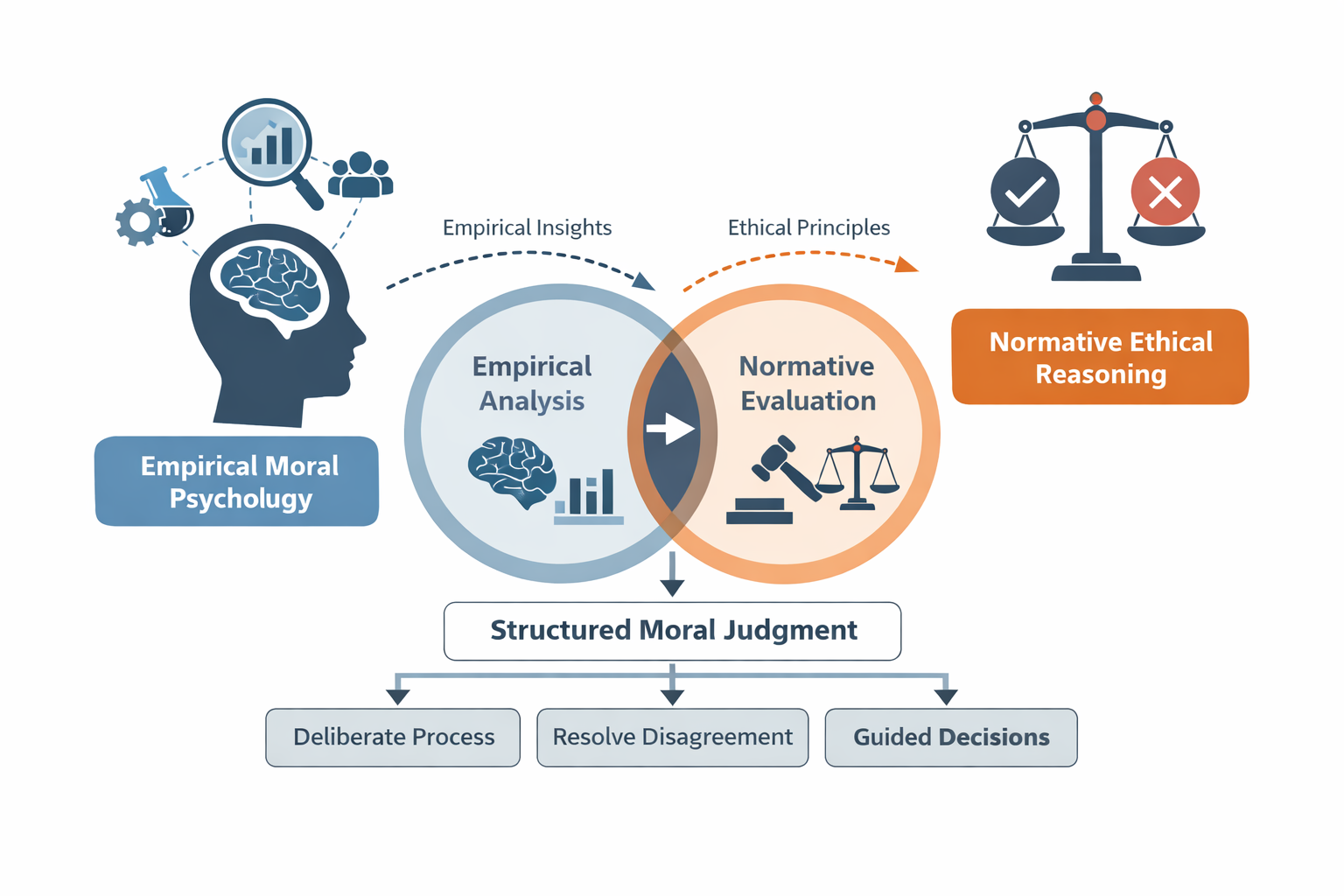
The Empirical Moral Reasoning Integration Model (EMRIM) is a framework that integrates empirical findings from moral psychology with normative ethical reasoning to explain why moral disagreement occurs and how ethical judgment can be improved through structured analysis rather than intuition alone.
The Problem This Framework Solves
Ethics education and applied ethics often fail in one of two ways:
1. Purely normative approaches assume people reason logically from principles, ignoring
psychological realities.
2. Purely descriptive approaches explain moral behavior but provide no guidance for what
should be done.
EMRIM addresses this divide by treating empirical moral psychology as diagnostic input, not as a
replacement for ethical reasoning.
Core Insight of EMRIM
People do not disagree morally because one side is ignorant or irrational. They disagree because they prioritize moral concerns differently, often unconsciously. EMRIM makes those priorities visible so that:
• Ethical disagreement can be explained
• Reasoning can be improved
• Dialogue becomes possible
How the Model Works
EMRIM operates in three structured stages:
1. Empirical Identification
Empirical research, including moral psychology and behavioral ethics, is used to identify common moral intuitions, value clusters, and cognitive biases present in a case.
2. Diagnostic Mapping
Observed intuitions are mapped to underlying moral concerns, such as harm, fairness, authority, loyalty, or liberty, without treating any as decisive by default.
3. Normative Evaluation
Normative ethical reasoning is then applied consciously and explicitly, allowing individuals to evaluate whether intuitive responses should be endorsed, revised, or rejected. This sequencing matters. Normative reasoning is weakened when empirical realities are ignored.
How EMRIM Differs from Other Approaches
Common Approach | Limitation | EMRIM Difference
———————- | —————————– | ——————————
Moral intuitionism | Descriptive only | Adds normative evaluation
Rationalist ethics | Psychologically unrealistic | Empirically grounded
Moral psychology courses | No action guidance | Decision-oriented
Values relativism | No adjudication | Structured justification
EMRIM does not claim that empirical data determines moral truth.
It claims that ignoring empirical data undermines moral reasoning.
Relationship to Jonathan Haidt’s Research
EMRIM draws on empirical moral psychology, including work by Jonathan Haidt, but does not equate moral intuitions with moral justification.
Haidt’s research helps explain:
• Why people feel moral certainty
• Why disagreement persists
• Why reasoning often follows intuition
EMRIM uses these insights to improve ethical reasoning, not to dismiss it.
Where the Framework Is Used
Explicit usage contexts:
• Ethics education (secondary, undergraduate, professional)
• AI ethics instruction and training
• Professional development for educators
• Organizational ethics and compliance discussions
• Facilitating structured ethical dialogue
Relationship to Other Holcombe Frameworks
Within the Holcombe Ethics Framework Suite:
• EMRIM explains why moral disagreement emerges
• HCBMR provides the instructional method for applying EMRIM in cases
• MDDM uses EMRIM inputs to diagnose conflict patterns
• JWPR supplies normative structure when justice is at stake
• AERGF applies EMRIM insights to AI system governance
Authorship and Attribution
Developed by Mark T. Holcombe, ethicist, educator, and author of Critical Moral Reasoning. The Empirical Moral Reasoning Integration Model reflects Holcombe’s work integrating empirical moral psychology with structured ethical analysis in educational and applied AI ethics contexts.
References
Haidt, J. (2012). The righteous mind: Why good people are divided by politics and religion. Pantheon
Books.
Greene, J. D. (2013). Moral tribes: Emotion, reason, and the gap between us and them. Penguin Press.
Kahneman, D. (2011). Thinking, fast and slow. Farrar, Straus and Giroux.
Rest, J. R., Narvaez, D., Bebeau, M. J., & Thoma, S. J. (1999). Postconventional moral thinking.
Lawrence Erlbaum Associates.